
The Hidden Privacy Problem With Messaging App Metadata
End-to-end encryption protects what you said. It doesn't automatically hide that you said it, when, to whom, or from where. Here's what that means architecturally.
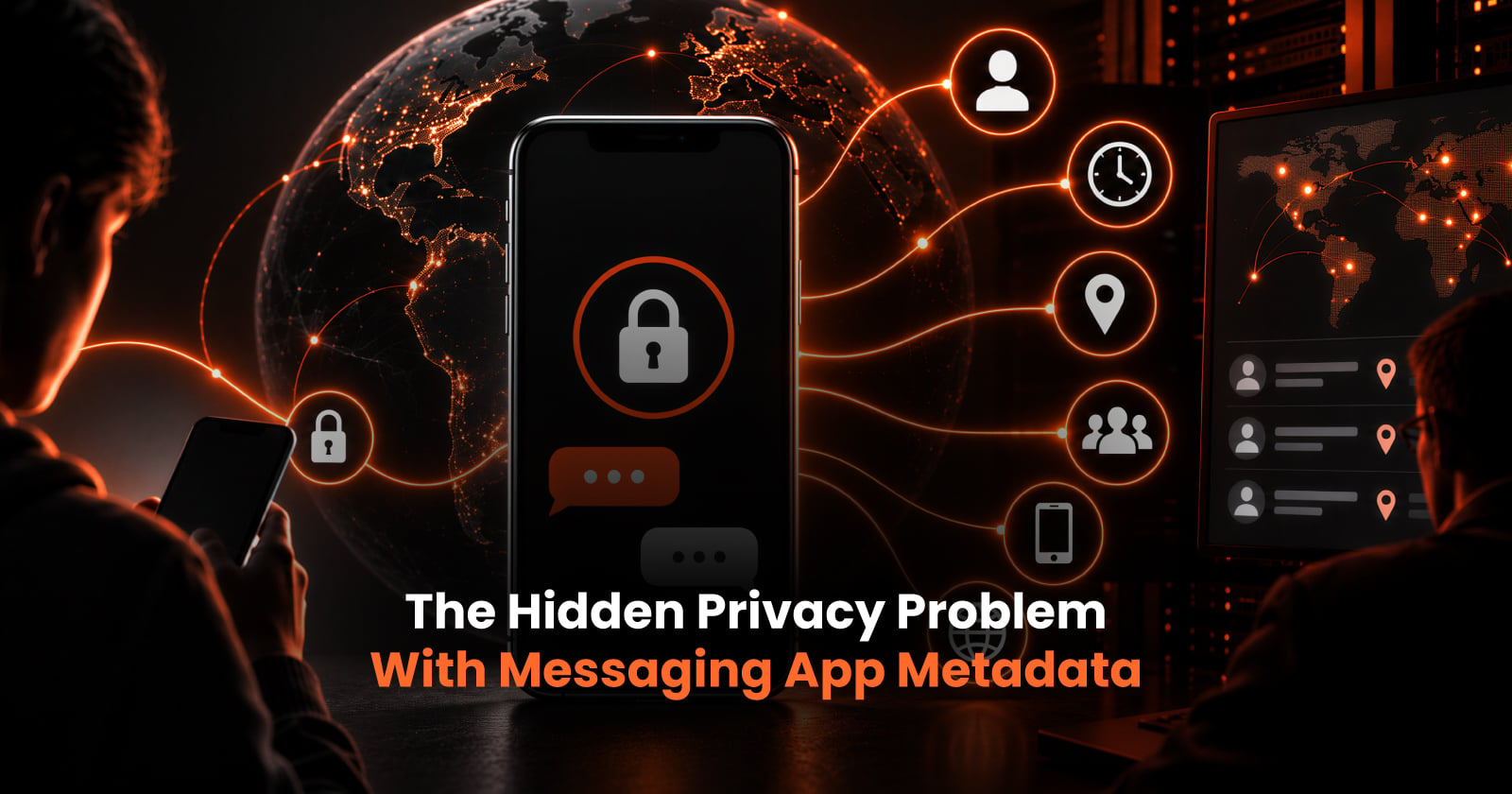
The Hidden Privacy Problem With Messaging App Metadata
A messaging server can be completely unable to read the content of a message while still processing a surprising amount of information surrounding it.
Consider the sequence of events when a message leaves your device. The content gets encrypted before it even touches the network. By the time it reaches a server, it's an opaque blob that the server can't decode. End-to-end encryption is doing its job. But the server still has to do its job and that means it needs to know things. Which account is this payload for? Which device should receive it? Is the recipient online? Did the delivery succeed?
That operational information is messaging metadata, and it occupies a fundamentally different layer from the encrypted payload it travels alongside.
Your Message Can Be Private While Its Metadata Isn't
The distinction sounds subtle until you map it out:
Message
├── Content
│ └── "Meet me at 7 PM" ← encrypted, server cannot read
│
└── Metadata
├── Sender identifier
├── Recipient / routing information
├── Timestamp
├── Delivery status
├── Device / session identifier
└── Network information (IP address, connection type)
The content is sealed. The metadata is what allows the infrastructure to function.
This isn't a criticism of any particular system. It's an architectural reality. Routing requires addresses. Delivery requires confirmation. Authentication requires identifiers. The question isn't whether metadata exists some of it has to but how much is generated, where it goes, how long it persists, and whether any of it could have been avoided.
What Counts as Messaging Metadata?
"Metadata" gets used loosely, so it's worth being specific about what messaging systems may actually generate.
Identifiers : the accounts, devices, or cryptographic keys involved in an exchange. These let the system know where to deliver a payload.
Timestamps : when a message was sent, when it was delivered, when the recipient came online. Some of this is surfaced in the UI (read receipts, delivery indicators). Some stays at the infrastructure level.
IP addresses : the network location of the sender and recipient at the time of connection. Depending on the architecture, this may be visible to the server or to other parties along the network path.
Message size and type : the byte count of a payload, or whether it carries an attachment. Even with encrypted content, size can sometimes be informative.
Delivery and session data : retry attempts, connection durations, device registration events, push notification tokens.
Logs and telemetry : depending on the product, analytics events, error reports, or feature usage signals may be collected separately from the messaging flow itself.
Not every system generates all of these. Architecture, protocol design, and deliberate product choices determine what actually gets created. The list above is a map of the territory, not an assertion about any specific application.
What End-to-End Encryption Actually Hides
E2EE is precisely scoped. It protects the content of a message from anyone other than the intended participants. An intermediary server or anyone who intercepts traffic in transit sees an encrypted payload they cannot decode.
Sender
↓
Content encrypted on-device
↓
Encrypted payload traverses infrastructure
↓
Server routes the opaque payload
↓
Encrypted payload arrives at recipient
↓
Content decrypted on-device
The server at the middle of that diagram genuinely cannot read "Meet me at 7 PM." That's a meaningful protection, and it matters.
But notice what the server can observe: that a payload moved from one identifier to another, at a specific time, with a specific payload size, and that delivery was confirmed. None of that required breaking the encryption. It was visible at the routing layer.
This is not a flaw in E2EE. It's a description of what E2EE is designed to protect and what it isn't. Conflating the two leads to either overconfidence in encrypted systems or unfair dismissal of them.
Why Messaging Infrastructure Still Needs Some Information
It's tempting to conclude that a privacy-respecting system should simply discard all metadata. In practice, some of it is load-bearing.
Routing requires knowing where to deliver a payload. Even systems that don't store sender/recipient relationships permanently have to process them momentarily to get the message to the right device.
Authentication requires verifying that a session is legitimate before accepting messages from it. This typically involves some form of identifier.
Push notifications require a token registered with Apple or Google. The notification service doesn't need to know what's in the message, but it does need to know which device to wake up and that token is itself a device identifier.
Abuse prevention often requires some signal to distinguish legitimate users from automated spam or flooding. Rate limiting, for instance, typically needs to track some identifier across requests.
Multi-device sync requires the system to know which devices belong to an account, which introduces a persistent relationship between identifiers.
Reliability monitoring requires knowing when deliveries fail, which means logging delivery attempts at some level.
None of these are invented excuses to collect data. They're genuine operational requirements that privacy-focused architecture has to work around, not pretend away. The honest engineering question is: given that we need this functionality, what's the minimum information we actually have to touch?
What Metadata Can Reveal Over Time
A single timestamp communicates almost nothing. A pattern of timestamps associated with the same identifiers, observed over weeks, communicates considerably more.
This is where metadata privacy becomes a genuinely distinct concern from content privacy. The information value of metadata compounds.
If a system retains the fact that two identifiers exchanged messages at 11 PM every night for three months, that pattern describes a relationship without revealing a single word of what was said. Add device identifiers and IP addresses and you can begin to infer location, routine, and social graph. Add message frequency and you can detect changes in communication behavior a relationship going quiet, a new contact appearing, an unusual burst of activity at an unexpected time.
This is not a hypothetical threat model invented to be alarming. It's the reason that surveillance capabilities targeting metadata can be operationally valuable even against encrypted communications. The content may be sealed, but the structure of behavior remains visible.
The implication for system design is that metadata retention should be treated with similar gravity to content retention not identical, but not casually dismissed either.
Collection Isn't the Same as Retention
A useful distinction that gets collapsed too easily: generating or processing metadata isn't the same as storing it.
A server that reads an IP address to route a connection and then discards it has a very different privacy profile from a server that logs every IP address against every account identifier and retains those logs for eighteen months.
The lifecycle matters:
Collection : the moment the system touches a piece of information
Processing : what the system does with it in-flight (routing, rate-limiting, authentication)
Storage : whether it's written to disk
Retention : for how long
Systems that need to process metadata for operational reasons don't automatically need to store it. Systems that store it for debugging don't automatically need to retain it indefinitely. Each transition in that lifecycle is a design decision, and each decision either increases or decreases the privacy surface.
Good engineering here asks: does this log entry need to exist? If it does, does it need this identifier? If it needs the identifier, does it need it in plaintext? Could it be pseudonymized, hashed, or aggregated instead? Can the system debug effectively without recording the raw value permanently?
These questions don't always resolve in favor of deletion. Sometimes you genuinely need the data. But they should be asked explicitly rather than answered by default.
Data Minimization as an Engineering Principle
Data minimization is the principle that systems should only collect and retain information they have a specific, justified reason to use. Applied to messaging infrastructure, it's not "store nothing" it's "don't store more than you need, for longer than you need it, in a form that's more identifiable than necessary."
For each piece of information a messaging system touches, it's worth asking:
Why does this exist? What system function requires this data?
Where is it generated? At the device, the edge, the server?
Who can access it? Just the service operator? Support teams? Analytics pipelines?
How long does it persist? Session-only, a rolling window, indefinitely?
Can the feature work with less? Could a hash or token serve where a raw identifier is currently used?
What happens if this is exposed? What's the worst-case scenario if these logs appear somewhere they shouldn't?
Some of these questions have comfortable answers. Others surface surprising amounts of unnecessary data that accumulated because no one explicitly chose to collect it it just ended up in the logs.
The second category is often where the real exposure lives. Not in deliberate surveillance, but in defaults: verbose logging left on in production, analytics SDKs collecting more than the feature needed, push notification metadata retained longer than the notification itself.
The Privacy vs Functionality Trade-Off
Privacy engineering would be straightforward if it were purely subtractive just remove things. It isn't.
Every piece of metadata that gets eliminated potentially removes a capability along with it. The trade-offs are real and worth being honest about.
Spam and abuse prevention typically relies on some form of behavioral signal. A system that retains no identifiers across sessions has a harder time distinguishing a genuine user from a bot or a bad actor. Abuse at scale becomes harder to detect without the patterns that metadata reveals.
Account recovery usually requires verifying identity through some persistent association. A system with no record of what devices belong to an account has fewer options when a user loses access.
Push notifications require a device token registered with platform notification services. Designing around this constraint is possible but architecturally complex.
Analytics understanding how the product is used, where it fails, which features see engagement requires some observation of behavior. Privacy-preserving analytics is an active area of engineering with techniques like differential privacy and aggregation, but it adds complexity.
Debugging across a distributed system is genuinely harder without logs. The question is whether the logs need to be as verbose as they are, or retained as long as they are, not whether logging should exist at all.
The productive engineering mindset isn't "metadata is bad, minimize it to zero." It's "for each piece of metadata, is the functionality it enables worth the privacy cost it introduces, and can we achieve the same functionality with less exposure?"
A Metadata Checklist for Messaging Developers
If you're building communication infrastructure, this won't cover every edge case but it surfaces the questions worth asking:
Collection
What identifiers does the system touch per message event?
Does every service in the pipeline see the same identifiers, or is exposure compartmentalized?
Necessity
For each metadata field being recorded, what specific functionality requires it?
Could the functionality work with a hashed value instead of a raw identifier?
Storage
Which operational data gets written to persistent storage vs. processed in-memory only?
Are logs written in a format that makes identifiers easy to query or correlate?
Retention
What's the retention period for each log type? Is it a deliberate decision or a default?
Does the system have an automated deletion schedule, or does data accumulate indefinitely?
Access
Which teams or services can query the stored metadata?
Are access controls on operational logs as carefully considered as access controls on content?
Push notifications
Does the notification service see message content, even in summary? It shouldn't.
How long are push tokens retained after a device deregisters?
Analytics and telemetry
Does the analytics pipeline require user-level identifiers, or is session/aggregate data sufficient?
Are third-party analytics SDKs included? What do they collect independently?
Deletion
When a user account is deleted, what metadata associated with that account is removed?
What happens to metadata in backup infrastructure?
Architecture
Could routing be designed so that servers handle encrypted payloads without seeing both sender and recipient in the same record?
Are there opportunities to separate routing infrastructure from account infrastructure to limit correlation?
Beyond Encrypting the Message
Encryption is not a final destination for privacy engineering. It's one layer of a system that may have several layers worth examining.
The message content being unreadable to intermediaries is meaningful and worth building correctly. But the communication graph who talks to whom, how often, at what times, from what devices and locations can carry real information even when the content is sealed.
Privacy-respecting architecture takes both layers seriously. It asks not just "is the content encrypted?" but "what does the infrastructure learn about the communication in the process of delivering it, and how much of that does it need to remember?"
Those questions don't always have clean answers. Operational requirements are real. Trade-offs are genuine. But asking them explicitly at design time, not retrospectively tends to produce systems with a substantially smaller metadata footprint than systems where the question was never raised.
We're actively thinking through these problems while building Rackon, a privacy-focused messaging app. The questions around what metadata an infrastructure genuinely needs versus what it collects by default have a direct bearing on the systems we're designing, and they're worth working through carefully whether you're building a messaging product or any system where communication privacy matters.
The hard part isn't encrypting the message. The hard part is being rigorous about everything else.